
Free brown noise player
Brown Noise for Deep Sleep
Short answer
Brown noise is a deep, steady rumble, like a waterfall or strong wind. It has more low sounds and fewer high, hissy sounds than white noise, so many people find it softer to sleep with. Press play to listen free here, or get the free BRW app for offline play, sleep timers and mixing.
What people use it for
Free sleep sound tools
Web player or app?
The web player is free and needs nothing installed. The free app does more.
| Feature | Web player | BRW app |
|---|---|---|
| Brown noise | ✓ | ✓ |
| Brown noise play time | 30 minutes | No limit |
| Works offline | — | ✓ |
| Sleep timer | — | ✓ |
| Plays while you use other apps | — | ✓ |
| Mix with rain and thunder | — | ✓ |
| Price | Free | Free download |
Want the details first? What the app does, and what "free" means.
Inside the app
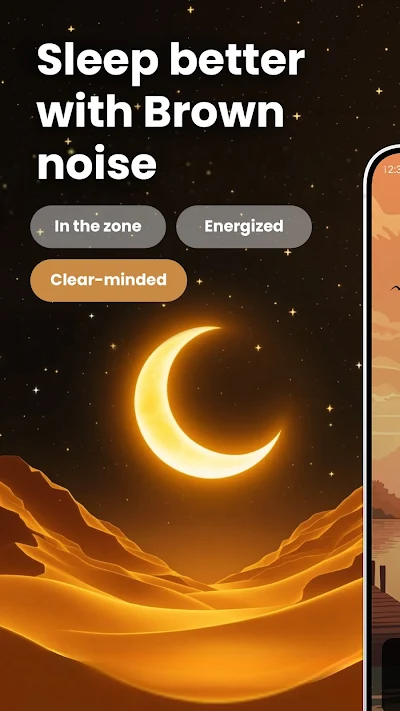
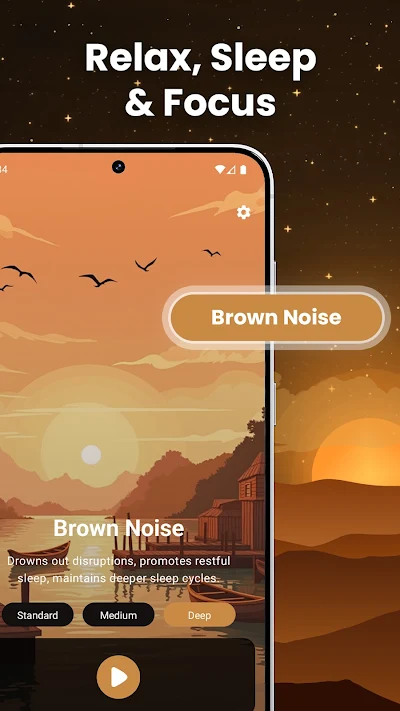
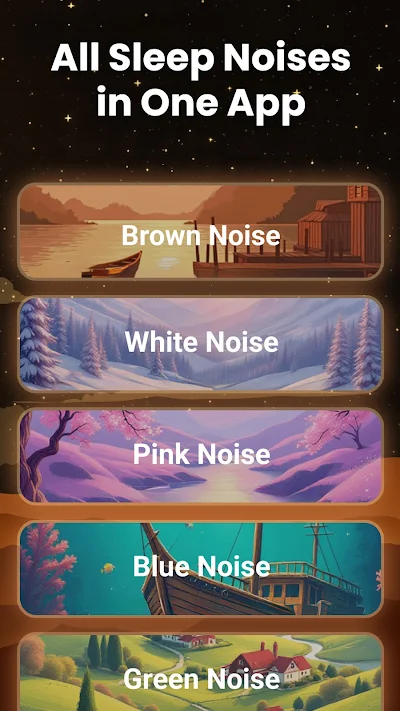
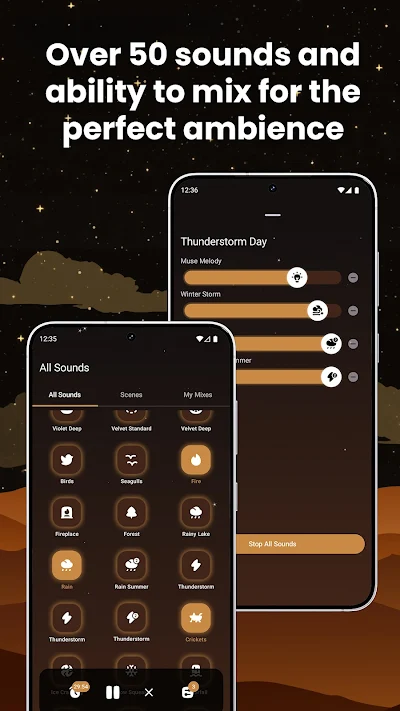
Five noise colours, more than 50 sounds, and a calm desert-night design.
What is brown noise?
Brown noise is a steady sound with lots of deep, low tones and very few high ones. It sounds like a strong waterfall, a river, heavy wind or distant thunder. You may also see it called Brownian noise or red noise.
The name comes from Robert Brown, the scientist who described Brownian motion: the random jiggling of tiny particles in water. Brown noise changes in the same random, step-by-step way. That is why it sounds smooth and rolling rather than sharp.
Because most of its sound is low, brown noise is good at covering other low sounds: traffic rumble, a neighbour's bass, an air conditioner, a washing machine in the next room. For the same reason it does little against high sounds, like a whistle or a high ring.
Brown, white or pink noise?
All three are steady, random sounds. They differ in how deep or bright they are.
| Brown | Pink | White | |
|---|---|---|---|
| Sounds like | Waterfall, strong wind | Steady rain | TV static, a fan |
| Feel | Deep and soft | Balanced | Bright and hissy |
| Covers well | Traffic, bass, hums | Some low and some high sounds | Sudden, sharp sounds |
| Try it if | White noise feels harsh | You want something in between | Sharp sounds wake you |
Not sure? Try all three. The app also has blue and green noise. Compare them side by side: brown vs white, brown vs pink and white vs pink. Or start from the noise you want to block: snoring, traffic, neighbours, or noise vs earplugs.
Does it really help?
Many people say they fall asleep faster and wake less with a steady sound in the background. A steady sound gives your brain nothing new to notice, so small noises like a car door or a dripping tap stand out less.
The research is weaker than the hype. A 2021 review of 38 studies found mixed results for steady noise and sleep, and rated the evidence very low. No good sleep study has tested brown noise on its own yet.
For focus, a 2024 review of 13 trials found a small benefit from white and pink noise for children and teenagers with ADHD, and a small drawback for those without ADHD. It found no studies of brown noise. If brown noise helps you, that is a real result for you, but science cannot confirm it yet. More on brown noise for ADHD and focus.
For tinnitus, brown noise is a comfort, not a treatment. A 2014 US guideline lists sound therapy only as an option. Read brown noise for tinnitus before you choose a sound.
Questions people ask
Is brown noise safe for babies?
Brown noise is generally considered safe for babies when it is quiet. Common advice is to keep it below about 50 decibels, which is about as loud as a quiet conversation, and to put the speaker at least a few feet from the crib. Advice varies. This is not medical advice: ask your baby's doctor first, especially if you have any worry about your baby's hearing or sleep.
Does brown noise help with tinnitus?
It depends on the sound you hear. Most people describe tinnitus as a high ring, whistle or hiss. Brown noise is mostly deep, low sound, so it covers a high ring poorly, and turning it up does not fix that. White or pink noise usually covers a high ring at a lower volume. Brown noise suits a low hum or drone, and some people like it simply because it is comfortable all night. Either way, it only makes tinnitus less noticeable while it plays. It is not a treatment: a 2014 guideline from the American Academy of Otolaryngology–Head and Neck Surgery lists sound therapy only as an option, and gives its full recommendation to cognitive behavioral therapy. Our guide to brown noise for tinnitus explains how to choose a sound and set a safe volume.
What is the difference between brown noise and white noise?
White noise sounds bright and hissy, like TV static, because it has as much high sound as low sound. Brown noise has much more low sound, so it is a deep rumble, like a waterfall, strong wind or distant thunder. Most people find brown noise softer and easier to listen to all night.
Why get the app instead of using the website?
The web player is good for a quick listen, but it stops after 30 minutes. The free app plays brown noise with no time limit, works offline, has a sleep timer that stops the sound for you, keeps playing while you use other apps, and lets you mix brown noise with rain, thunder and other sounds.
Get BRW on iPhone or Android
Brown Noise for Sleep: Brw is on the App Store for iPhone and iPad. Brown Noise, Sleep Sounds: BRW is on Google Play. Both are free and play offline with sleep timers.
The iPhone app needs iOS 17.0 or later. You do not need an app to listen: the player at the top of this page is free.
Health note
This site gives general information, not medical advice. Brown noise does not diagnose, treat or cure any condition, including insomnia, tinnitus, ADHD, or any hearing or sleep problem. Talk to a doctor, an audiologist or your child's doctor before you rely on sound for a health problem, and before you use it with a baby. If you notice ear pain, discomfort, or sleep problems that do not go away, stop and get medical advice.